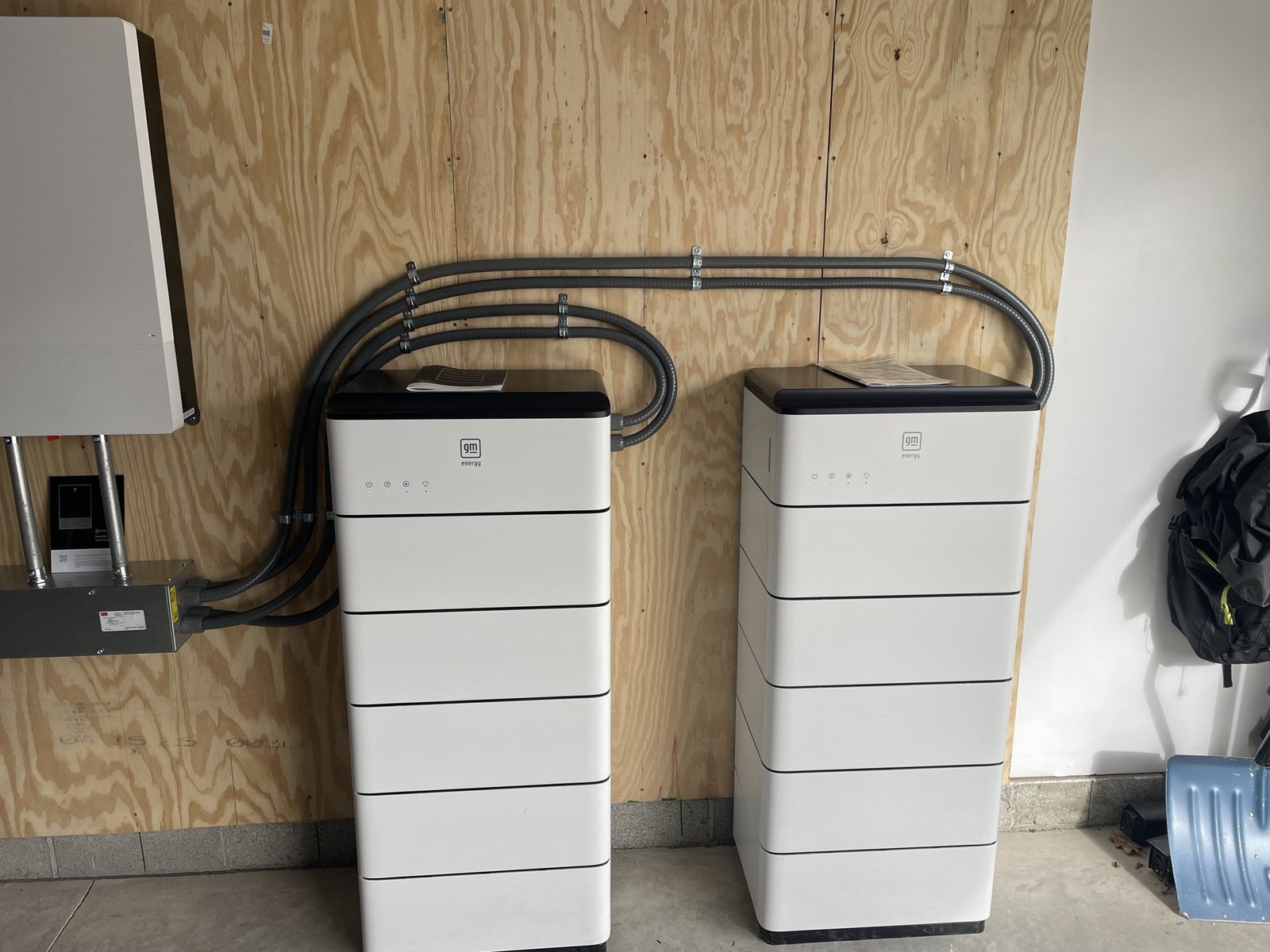
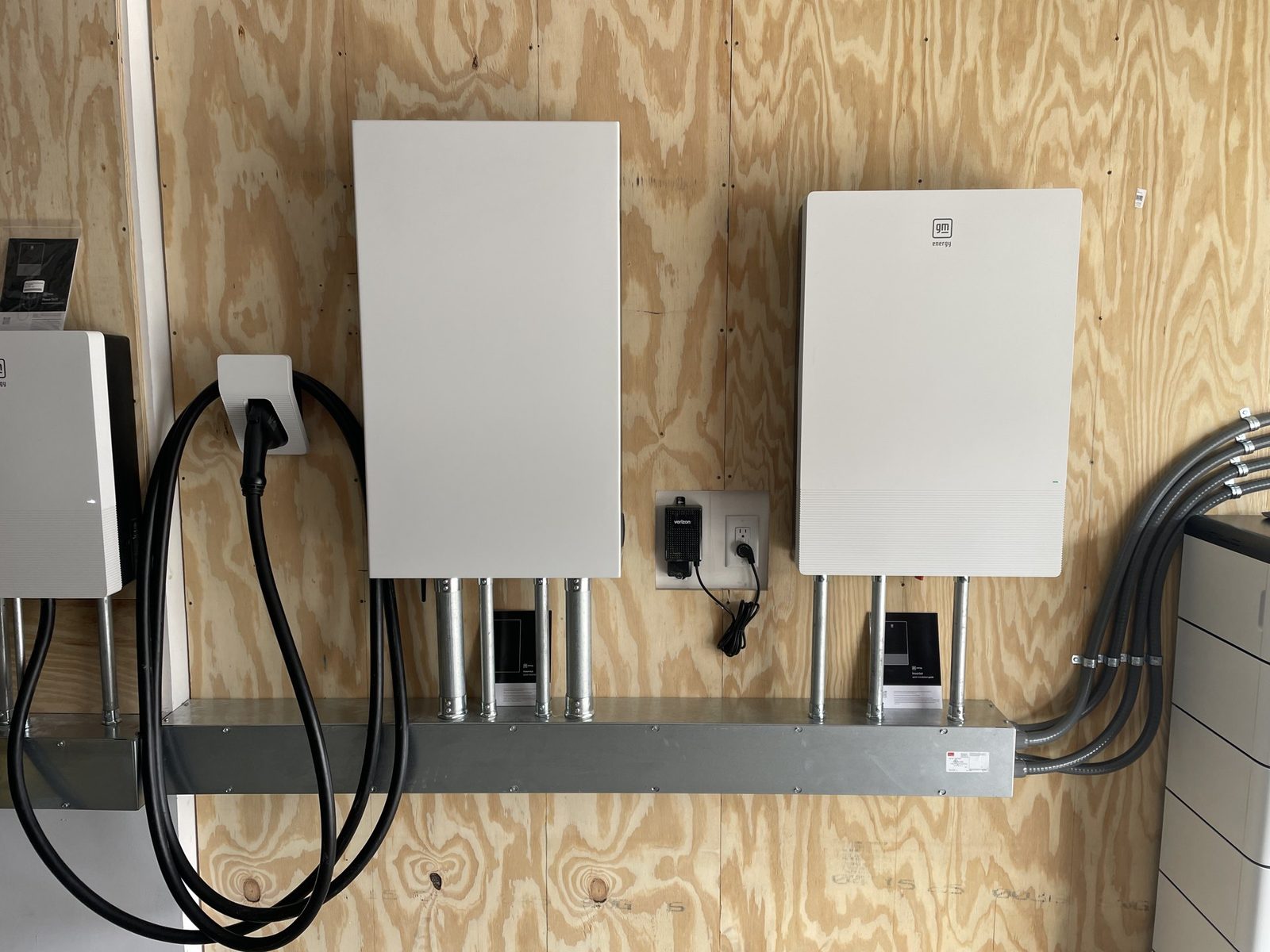
Tesla Powerwall 3 and GM Energy battery systems, installed by the Class A electrician who designs them. Keep your power on through outages — and where your utility's rate plan allows, lower your bill on the days the grid is up.
Get a battery quote → See the honest math
Pick the picture that matches you. We'll size and price accordingly — and if a battery isn't the right answer for your home, we'll say that too.
The grid drops, your house stays on before you notice. This is the most common battery install we do in Central Virginia. Most single-battery backup installs land in the $13,500–$14,500 range — you'll get the exact, no-fee number before any work starts.
On a time-of-use rate plan, we program the battery to charge overnight and carry your house through the expensive hours. Whether that's worth real money depends entirely on your utility — the honest math is below, utility by utility.
Powerwall 3 stacks cleanly and is solar-ready out of the box — add a second unit or panels later without redoing the install. Drive an EV that can power your home? A battery and V2H cover different outage lengths; we'll show you how they fit together.
Plenty of battery marketing quotes "3-cent overnight power" as if it were universal. It isn't — those rates belong to certain electric co-ops, not Dominion. Here are the real, currently-verified numbers.
| Dominion Off-Peak Plan — summer | Rate (verified July 2026) | What the battery does |
|---|---|---|
| Super off-peak (midnight–5am) | 13.36¢/kWh | Charges battery |
| Off-peak (all other hours) | 15.1¢/kWh | House runs on grid |
| On-peak (3–6pm weekdays) | 31.05¢/kWh | House runs on battery |
Winter shifts the windows (on-peak 6–9am & 5–8pm weekdays at 27.1¢; super off-peak 14.96¢). Dominion's standard rate is about 16¢ all-in. The straight story: the summer spread is real — roughly 18¢ on every kilowatt-hour the battery shifts into that 3–6pm window — but the window is three hours on weekdays, not all day. We run the math on your actual usage before any savings number goes in your quote.
Across our Central Virginia service area, customers fall under at least four different utilities — and the battery math changes at each one.
Off-Peak Plan — three tiers, verified above. The battery play: charge at 13.36¢ overnight, ride out the 31¢ summer peak.
No residential battery rebate exists today, and we won't pretend otherwise. A statewide virtual-power-plant pilot that would pay battery owners is awaiting a regulatory ruling — join our list and you'll hear the moment it's real.
Schedule A-1-TOU — off-peak at 3.8¢/kWh, available to REC members now. This is the genuinely cheap overnight power the ads talk about.
One trade-off: REC's TOU customers aren't eligible for net metering — if solar is in your future, we'll walk through which path wins before you enroll.
Demand billing changes everything. Every SEC residential bill includes your single highest 15-minute draw × $3.38/kW. A battery that shaves that peak pays back differently — and sometimes better — than any TOU arbitrage.
SEC also offers A-TOU (off-peak ~4.1¢), but TOU and net metering are mutually exclusive there. We size SEC batteries to your demand profile, not a brochure.
No residential TOU rate today — so we won't quote you rate-arbitrage savings, because there aren't any. A CVEC battery is bought for backup, and it's excellent at that.
CVEC does offer net metering, which matters if solar enters the picture later.
Don't know which utility serves you? It's at the top of your last bill — or give us your address and we'll tell you in 30 seconds.
Every battery install is permitted, inspected, and commissioned — designed by the same Class A electrician who installs it.
Depends on what you back up. A single Powerwall 3 (13.5 kWh) runs essentials — fridge, internet, lights, well pump, one HVAC zone — for roughly 12–24 hours. Two Powerwalls double that. We size based on your actual outage history, not worst case.
No. Backup-only is the most common battery install we do, and where a time-of-use plan is available at your address (see the availability note above), rate optimization adds a second layer of value. Powerwall 3 is solar-ready — panels can come later, when the timing makes sense for you.
Not today — Dominion has no residential battery program right now, and we won't quote savings that don't exist. A statewide virtual-power-plant pilot that would include home batteries is awaiting a regulatory ruling. Join our list and we'll tell you if and when it becomes real.
We install Tesla Powerwall and GM Energy systems today. If you drive (or plan to drive) a GM EV, the GM Energy system pairs with vehicle-to-home backup; Powerwall 3 is the standalone workhorse and the natural fit for Tesla households. FranklinWH — the brand-agnostic option that also plays well with generators — is next: our certification is in progress, and we'll add it to this lineup the day it's earned, not before. Either way, we match the system to your vehicles and your panel — not to a sales quota.
Yes. Powerwall 3 stacks cleanly, and we design the first install with that path open.
One day on site for most homes. Permitting and commissioning add one to three weeks of total timeline, depending on the inspector's schedule — we handle all of it and keep you posted by text.
No oversizing, no upselling. We'll look at your bill, your panel, and your outage history — then quote what actually fits. You'll hear from us right away — and a real person, usually Jonathan, follows up within one business day.